
2015 November 25
It all started last year (2014) when I realized that our Null Paradox rock opera needed an upgrade in writing, lighting, and set design. Fortunately I’ve had the privilege of working with artists who have inspired and helped me in these areas. But, there’s nothing like rolling-up your sleeves and immersing yourself into all of it.
So, it was time to go back to school and study these areas in-depth with a group of professors who have hundreds of years of experience in live theater and musicals between them. At the very least, I wanted to learn enough so that I could effectively communicate with other artists who work in these specialities. I also wanted to meet more people in the artist community across the world.
I spent a year (2014) taking writing and film classes to understand how to better tell a story at Oakland Community College in Farmington Hills, Michigan. One of the outcomes was my short film Fragile Soul. Although scheduled for a 2015 release, this movie is a work-in-progress and will be released in 2016 (maybe). Why? Because I’ve learned so much about telling a story through visual and audio forums since we originally shot the film.
Today
Which brings me to today, which is essentially my first day off since starting the Masters of Fine Arts program at Wayne State University in Detroit during August of this year (2015). It’s been a rollercoaster ride of long hours with many days starting at 7am and often ending at 2am. With those long hours I’ve begun the next stage of learning from a group of very talented lighting, scenic, prop, sound, and costume designers. And there’s a wonderful team of directors, actors and dancers here as well. All of whom work together with student Stage Managers to bring together live plays and dance performances within four theaters on campus.
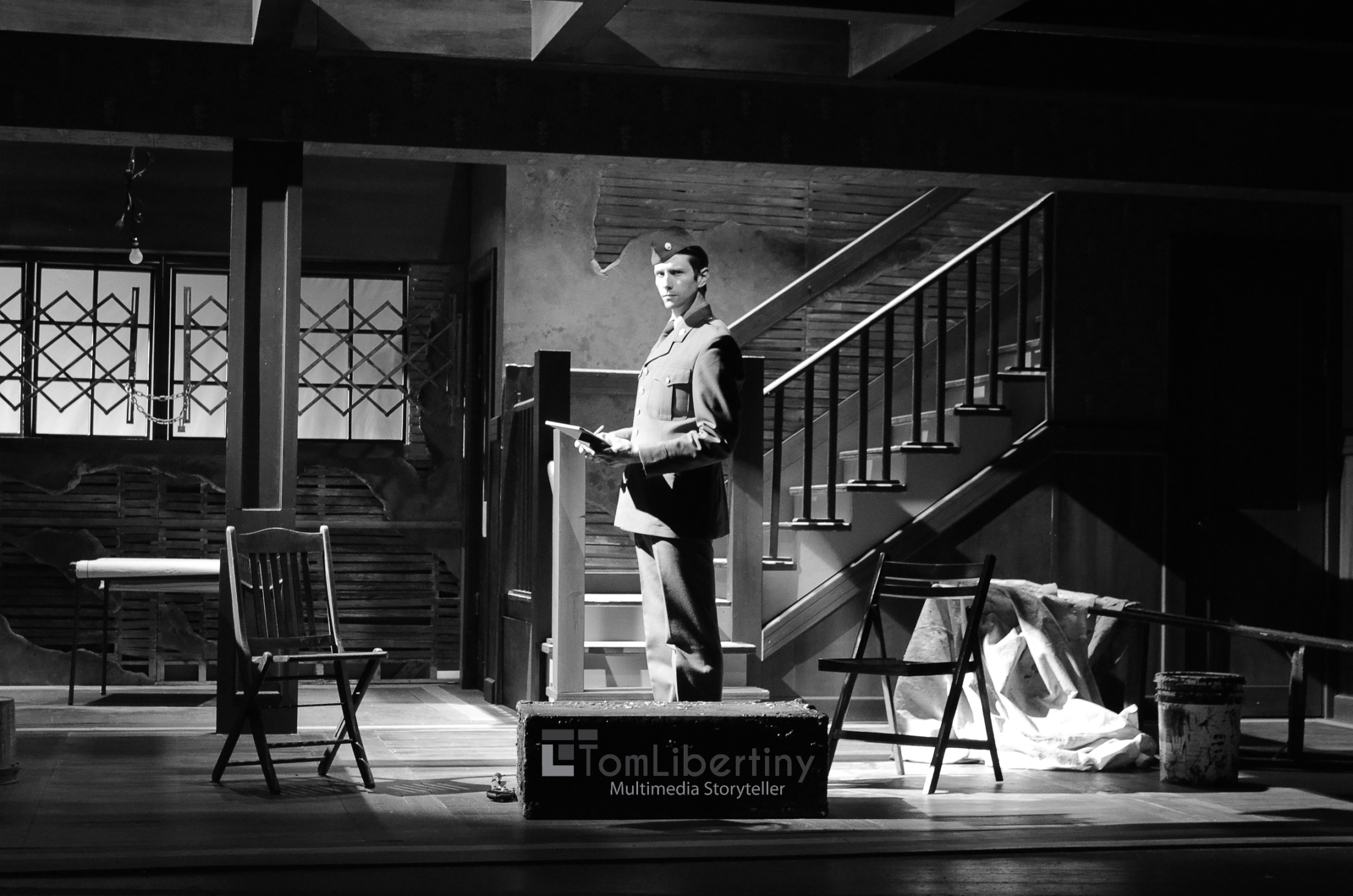
I’m getting my feet wet at this point, but you can see a little bit of my work as a master electrician in the recent production of The Great Gatsby which was performed at the Hilberry Theatre in Detroit. That was followed-up by my work as the lighting designer for To Sangana at the Maggie Allesee Dance Theatre. And I’m presently working on composing and sound design for Inspecting Carol which opens next month at the Hilberry Theatre with a 15.1 surround sound system.

Lighting Design and Photography by Tom Libertiny
How does this all relate back to Null Paradox?
First, I’m working with world-class people who have a lot of experience. And they make their own stuff. Need a set made of clear Lexan (plastic sheet) with custom-made lighting fixtures? Or a set with a floor that collapses with hydraulics (Inspecting Carol)? Or a set that incorporates the attributes of fine furniture with five built-in projection screens (Great Gatsby)? It’s all designed and manufactured by our students and our faculty advisors on campus.
They’re also very clever with the use of a limited budget. I used to think that repairing a lighting or sound instrument meant calling the manufacturer and shipping back equipment to them and paying a hefty fee. Not here. With time being of the essence and a lot of our equipment being out of warranty, we repair everything here, down to troubleshooting and replacing individual computer chips. The result: a big savings in our equipment budget which is better spent on things like materials for sets (scenic), props, wardrobe, and promotion.
Work Ethic
And then there’s the work ethic of the students and our faculty advisors. Our artist’s level of dedication and the long mornings, days, and nights they spend seven days a week would put them in good company in the world of the heavy manufacturing industry. Which is to say: my expectation of my own performance level and those who I work with has taken a huge step forward.
Stage Managers. I now fully appreciate that a great Stage Manager has to understand both the big picture of the Director’s vision and every detail encompassed by all of the other design disciplines. They run the show. It’s a very difficult job but critical to producing a high quality show.
Scheduling
Time is something that we can’t afford to squander. This leads to efficiency in everything that we do. While we’d all love to spend 8 weeks in preparatory rehearsals, 6 weeks in tech, and a month in dress rehearsals, that’s not something that’s affordable from a time or budget perspective. I’ve learned to be efficient with my time and how to compress what would be a two or three-month long process into two weeks. I’ve also learned that during any formal meeting with a team, the expectation is that everyone has completed their individual tasks on their own time which leaves the valuable time used during a meeting to look at big picture issues, rehearse as an overall team, and work out details. The level of commitment and professionalism to their craft by all of the artists here is impressive.
You’ll absolutely be seeing all of these learning experiences come together when Null Paradox performs again during the summer of 2016. I can’t wait to share with you.
Theatre Tour
Hilberry Theatre
Located on the Wayne State Campus in Detroit, this was one of the two primary theatres in which I worked.
It began as the First Church of Christ, Scientist, a Neoclassical building constructed in 1916–1917. Wayne State University purchased the property in 1961, remodeled it as a 534-seat open-stage auditorium with Elizabethan and Roman influences, and reopened it in January 1964. The theatre was named for the university’s fourth president, Clarence B. Hilberry, an English professor.
For nearly sixty years it served as the primary performance and training space for Wayne State’s graduate theatre program, which enrolled roughly forty to fifty M.F.A. students in acting, directing, design, and stage management. Widely regarded as one of the country’s leading training grounds for emerging theatre professionals, it presented both classic and contemporary plays. The building was a contributing property in the Wayne State University Buildings historic district.
The theatre closed in late 2022, after its final production, The Merry Wives of Windsor. The historic structure was subsequently renovated and reopened as the Gretchen C. Valade Jazz Center, a 350-seat jazz performance hall with a new Underground Jazz Café.


Bonstelle Theatre
This theatre was a short walk from Wayne State’s main campus.
Designed by the architect Albert Kahn as Temple Beth-El, it opened in 1903 as a Beaux-Arts-style synagogue with a prominent dome and classical influences.
After the congregation moved to a new location in 1922, the building was converted in 1925 into the Bonstelle Playhouse by the actress-director Jessie Bonstelle, who turned it into a major regional theatre.
In 1951 Wayne State University (then Wayne University) rented the facility as a permanent home for its undergraduate theatre company and purchased it outright in 1956. The university officially restored the name Bonstelle Theatre in 1963 in honor of its founder.
For nearly seven decades it served as a 1,200-seat Broadway-style proscenium theatre, hosting four mainstage productions a year by WSU undergraduates as well as occasional professional and community events. Notable alumni who performed there include Lily Tomlin and Ernie Hudson.
What many people didn’t know at the time: when the synagogue was converted to a theatre, the original front fascia wasn’t torn down, it was hidden behind the new fascia in the 1920s. Having access to all areas of the building, you could actually climb down between the new and old fascias.
Another key feature was the glass ceiling dome that was covered by a suspended ceiling during the same conversion. But there was access to the original dome for lighting designers and the huge steel structure and dome were still in place, simply hidden from the audience.
Then there’s the Jessie Bonstelle “apartment.” She had a hidden room above the main theatre seating area where she could view the performances in private. It’s rumored that she also lived there throughout her time as the operator of the theatre. When I worked there, the ghost of Jessie roamed throughout the theatre.
The building was listed on the National Register of Historic Places in 1982 and was a contributing property in the Midtown Woodward Historic District.


